
Part 1: A Christmas Betrayal: When Family Turns Against You
What hurt most that Christmas wasn’t the argument.
It was watching my mother-in-law point at my three-year-old daughter and drag her into a fight she had nothing to do with.
Christmas at the Whitmore house always felt more like a performance than a family gathering.
Silver candlesticks ran down the table. Crystal glasses caught the chandelier light. A twelve-foot Christmas tree glowed beside the fireplace.
And Diane sat at the head of the table like the entire evening belonged to her.
Under the table, my husband Ethan gave my knee a gentle squeeze.
“Just make it through dessert,” he whispered.
Then his sister Vanessa started.
“So, Claire,” she said, turning her wineglass between her fingers, “are you still doing that little consulting thing?”
“Yes.”
“How cute.”
Vanessa knew exactly what I did.
I advised companies during mergers, acquisitions, and major restructuring. She had even asked me for professional help with her interior-design company.
A few minutes later, she started complaining that Ethan had refused to put another fifty thousand dollars into her business.
“That money belongs to us,” Ethan said.
Vanessa looked straight at me.
“You mean it belongs to her.”
I set my fork beside my plate.
“Actually, I was the one who advised Ethan not to invest.”
Her smile disappeared.
“And why is that?”
“Because your company hasn’t paid its payroll taxes in eight months.”
The table went silent.
“You went through my financial records?”
“You sent them to me because you wanted professional advice.”
“You judgmental little…”
“Enough,” Ethan said.
That should have ended it.
Instead, Diane stood.
Her chair scraped across the hardwood.
“You’ve turned my son against his own family.”
I stayed seated.
“I stopped him from putting money into a company with serious financial problems.”
Diane crossed the room.
Then she struck me.
Ethan was on his feet immediately.
“Mom!”
But Diane lashed out again, then a third time before Ethan stepped between us.
No one at the table moved.
Diane leaned around her son and stared at me.
“You’re nothing but trouble. My son deserves better.”
Then she turned toward Lily.
My daughter was standing beside the Christmas tree, holding her stuffed rabbit against her chest.
She was three years old.
She had nothing to do with Vanessa’s business, Ethan’s money, or the argument.
Diane pointed toward her anyway.
“Take her and get out.”
For one second, I thought Ethan might try to calm everyone down.
He didn’t.
He reached for my hand, lifted Lily into his arms, and said, “We’re leaving.”
No debate. No apology to keep the peace.
Behind us, Diane laughed.
“Good. And don’t come running back when she ruins your life!”
I walked toward the front door.
Then I stopped.
Not to argue.
I looked back at the marble staircase, the custom chandelier, the expensive paintings, the furniture Diane loved showing off whenever guests came over.
Then I looked at her.
“Merry Christmas.”
She stared at me like she had won.
What Diane had apparently forgotten was that the house wasn’t hers.
Three years earlier, when she and Robert were facing foreclosure, my private investment company had purchased the property and allowed them to stay under a family occupancy agreement.
They paid no rent.
There had been no public humiliation. No eviction. No family scandal.
But the agreement had conditions.
And what happened that night had crossed one of the most important ones.
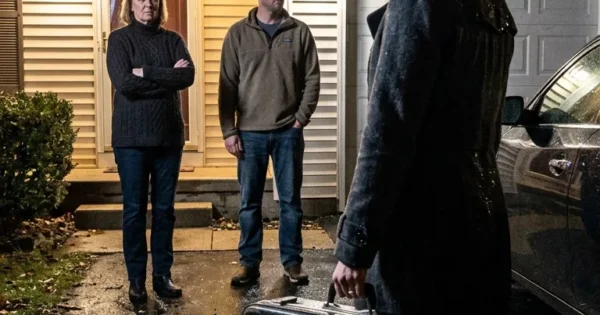
Two hours later, Ethan and I were back at our apartment.
Lily had finally fallen asleep beside us, her stuffed rabbit tucked beneath one arm.
Then Ethan’s phone rang.
His father’s name appeared on the screen.
“Dad?”
Robert sounded shaken.
“Your mother just found out.”
Ethan looked at me.
“Found out what?”
A long silence followed.
Then Robert lowered his voice.
“Who actually owns the house.”
Ethan slowly turned toward me.
And I knew Christmas dinner was only the beginning.
Was Diane’s outburst enough to justify enforcing the agreement, or should family still be given another chance after crossing a line like that? Protecting your child matters, but so does the weight of what happens next.
She thought Claire had been allowed into the family. She never realized Claire had been the one quietly keeping the family in that house.

Part 2: The Heartwarming Resolution: Healing Family Wounds
(Part 2)
“Who actually owns the house.”
For a moment, Ethan said nothing.
Then he asked, “How did Mom find out?”
Robert hesitated.
“She started going through the old paperwork after you left. She found the occupancy agreement.”
Three years earlier, Diane and Robert had been weeks away from losing the Whitmore house.
Ethan wanted to help, but there was no realistic way for him to take on their debt without putting our own finances at risk.
So my private investment company bought the property.
Diane and Robert were allowed to stay there rent-free under a family occupancy agreement. The arrangement protected them from foreclosure without turning their financial trouble into a public family disaster.
There were conditions.
The property had to be maintained.
It could not be used as collateral.
And the household could not be used to threaten, harass, or endanger members of the family covered by the agreement.
Until Christmas night, I never imagined that clause would matter.
Robert’s voice dropped.
“She wants to talk to you.”
A second later Diane came on the line.
Her voice sounded different now.
“Claire, apparently there has been some misunderstanding about the house.”
“No misunderstanding.”
“You own it?”
“My company owns it.”
Silence.
Then she tried to recover.
“Well, we’re family.”
Two hours earlier, she had struck me three times, called me trash, pointed at my daughter, and ordered us out.
Now she wanted to discuss family.
Diane continued.
“People say things when they’re angry.”
“You didn’t just say something.”
“I was upset.”
“You brought Lily into it.”
“She shouldn’t have been standing there.”
That sentence settled it for me.
Not the house.
Not the money.
Not even what she had done to me.
She had found a way to make a three-year-old responsible for being present while adults behaved badly.
I kept my voice calm.
“Diane, don’t apologize because you found out who owns the house. If you’re going to apologize, apologize for what you did to Lily and to me.”
Nothing came back.
Then she asked, “So what happens now?”
There it was.
Not “Is Lily okay?”
Not “I’m sorry.”
What happens to the house?
I looked at Ethan.
He gave a small nod.
“The occupancy agreement will be handled according to its terms,” I said.
Her voice sharpened.
“You would throw your husband’s parents out?”
Ethan leaned toward the phone.
“Mom, stop.”
She went quiet.
“You threw my wife and my daughter out on Christmas,” he said. “You don’t get to act shocked because there are consequences.”
For the first time all evening, Diane had no answer.
The next morning, I reviewed the agreement again.
I did not make an angry decision at midnight.
I did not change locks or try to humiliate anyone.
I followed the document Diane had lived under for three years.
My company issued formal notice that the family occupancy arrangement was being terminated under the conduct provision she had violated.
They were given time to make other housing arrangements.
Robert called later.
“I understand,” he said quietly.
I expected him to defend her.
He didn’t.
“You saved this house for us once. She started thinking that meant it belonged to her.”
Across the room, Lily sat on the floor with her stuffed rabbit and new crayons.
Ethan sat beside me.
“My loyalty. Your patience. She thought those belonged to her too.”
A few weeks later, the Whitmore house was no longer Diane’s stage.
The decorations came down. The rooms she treated like proof of her authority became what they had always been on paper: property she had been allowed to occupy because someone she looked down on had once chosen to protect her dignity.
I never wanted gratitude for saving the house.
I wanted accountability.
Diane never gave me the apology I would have respected.
But she never again spoke to me as though I had to earn a place in my own family.
And Ethan never again asked me to “just make it through dessert.”
That Christmas taught us that keeping peace is not the same thing as keeping a family healthy.
Sometimes everything changes when someone finally stops pretending a boundary is negotiable.
Was ending the occupancy agreement a fair consequence, or did Claire’s financial power make the punishment too severe? Family generosity can be real, but so can the point where generosity becomes permission.
The house was never the real issue. Diane’s first question after learning the truth showed exactly what mattered most to her.
A tense Christmas dinner in an elegant family home as a mother protects her three-year-old daughter near a glowing tree while stunned relatives watch in silence.
Discover more heartwarming stories and emotional moments on our main editorial page.
The Night Mother Threw — An Inspiring Story — An Inspiring Family
Read Full Story ➡️