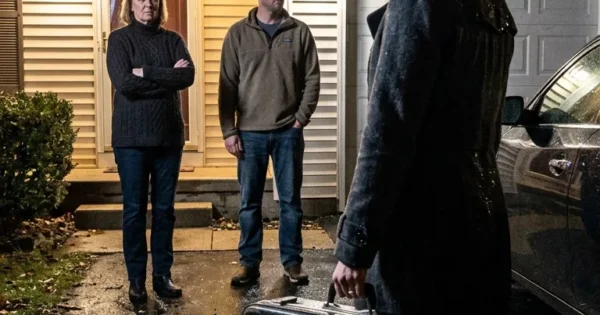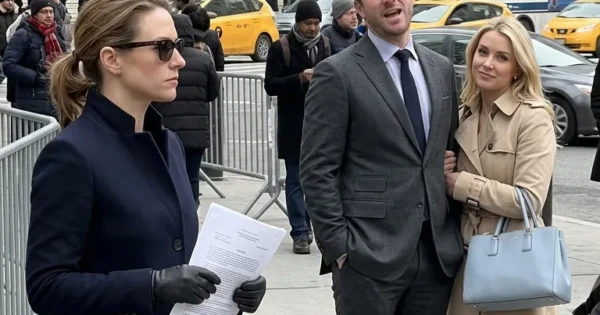

This Lake House Trust begins…
Table of Contents
Part 1: Lake House Trust – The Unfolding Story
At 6:47 on a Tuesday evening, Margaret Ellis was stirring chicken and dumplings when her daughter’s voicemail changed everything she thought she knew about her own family.
Steam curled off the pot, her hands too wet to grab the phone, so she hit speaker with her wrist.
“Hey, Mom. Ryan and I talked, and we think it’s better if you don’t come to the lake house this summer. The kids want friends there, Ryan’s parents are flying in, and there just isn’t enough space. We’ll plan another visit later. Love you.”
The call ended before she could say a word.
She stood there until the pot boiled dry, steam fogging the window over the sink that used to look out on Thomas trimming the hedge every August.
Margaret Ellis, sixty‑eight years old, a retired nurse and widow, had spent thirty years listening to her husband Thomas dream about a house on Lake Oconee before he ever saw it built.
The house went up the year after Thomas died, funded by life insurance, most of her retirement, and a contractor named Earl Bennett who took her husband’s napkin sketches seriously when nobody else would have.
Pine floors were chosen because Thomas loved the grain, and a sage‑green door was painted because he said green felt like coming home.
The porch swing was moved eight inches west on Earl Bennett’s crew’s last afternoon so the sunset would land exactly the way Thomas had pictured it.
The first summer, the house filled with Claire, Ryan, the kids, Daniel, and her sister Ruth, while Thomas’s photo sat on the mantel and the place buzzed with the kind of noise that makes an empty house worth building.
Somewhere after that, the lake house stopped feeling like hers in anybody’s mind but her own.
Ryan began with a bigger dock, then new patio furniture, a gas fire pit he priced without asking, and later a guest room quietly claimed as his office because he worked from home.
Nobody discussed the changes; they simply happened, the way water finds a crack.
Claire stopped asking what Margaret wanted and started telling her what had already been decided.
After Thanksgiving she pulled Margaret into the kitchen, dish towel still in her hand, and said, “Mom, Ryan and I were thinking. Since we use the lake house more than anyone, maybe you should transfer it into our names. Simplify things. Taxes, mostly.”
Margaret looked at her the way she used to look at a chart that didn’t add up and replied, “It’s already simple. It’s in my name. That’s where it’s staying.”
Claire smiled as if Margaret had agreed to think about it.
Two weeks later a letter arrived from an attorney Margaret had never met, recommending she “voluntarily transfer ownership” to her daughter and son‑in‑law because they were the property’s primary users.
A signature line waited at the bottom of the letter like it was owed something.
Margaret folded that letter and put it in the drawer beside Thomas’s wedding ring, choosing not to call Claire or the attorney.
She let July come, watching the days pass while the tension simmered beneath the surface.
On the Fourth of July, Claire, Ryan, their kids, and Ryan’s parents arrived with coolers, inflatable floats, and a sense of ownership as they piled out of four car doors at once.
Margaret watched from the porch swing, noting that nobody looked up to see if she was even there yet.
Lorraine, her neighbor two docks down, called her screaming about a strange car sitting in the driveway.
“Margaret, there’s a car here I don’t recognize. Should I call someone?” Lorraine shouted.
Margaret looked out at the water, at the sunset falling exactly where Thomas said it would, and replied, “I made space.”
She hung up the phone, feeling the weight of the moment settle over her like the evening haze.
Thomas had built the house so their family would always have somewhere to land, not so someone could hand her a letter and a signature line and call it simplifying things.
Some people said she should have fought that letter the day it arrived, calling her own lawyer to put a stop to it before it went any further.
Others said silence is its own kind of answer, that sometimes you let people show you exactly who they are before you decide what to do about it.
Margaret still did not know which version of herself was right—the one that stayed quiet or the one that was about to stop.
She wondered whether the version of her that stayed quiet was wise or whether the version about to act would be the truer expression of her love for the house.
The attorney’s letter lingered in her mind, especially the phrase “primary users,” which seemed to carry more weight than its simple wording suggested.
As the fireflies began to dance over the lake, Margaret felt the quiet strength of her husband’s vision anchoring her to the present moment.
She resolved that whatever came next, the lake house would remain a sanctuary on her terms.
Part 2: Lake House Trust – The Final Truth
The strange car in Margaret’s driveway belonged to Tom Bennett, Earl Bennett’s son, now a real estate attorney in Atlanta, and the only person she trusted enough to call the week that letter arrived.
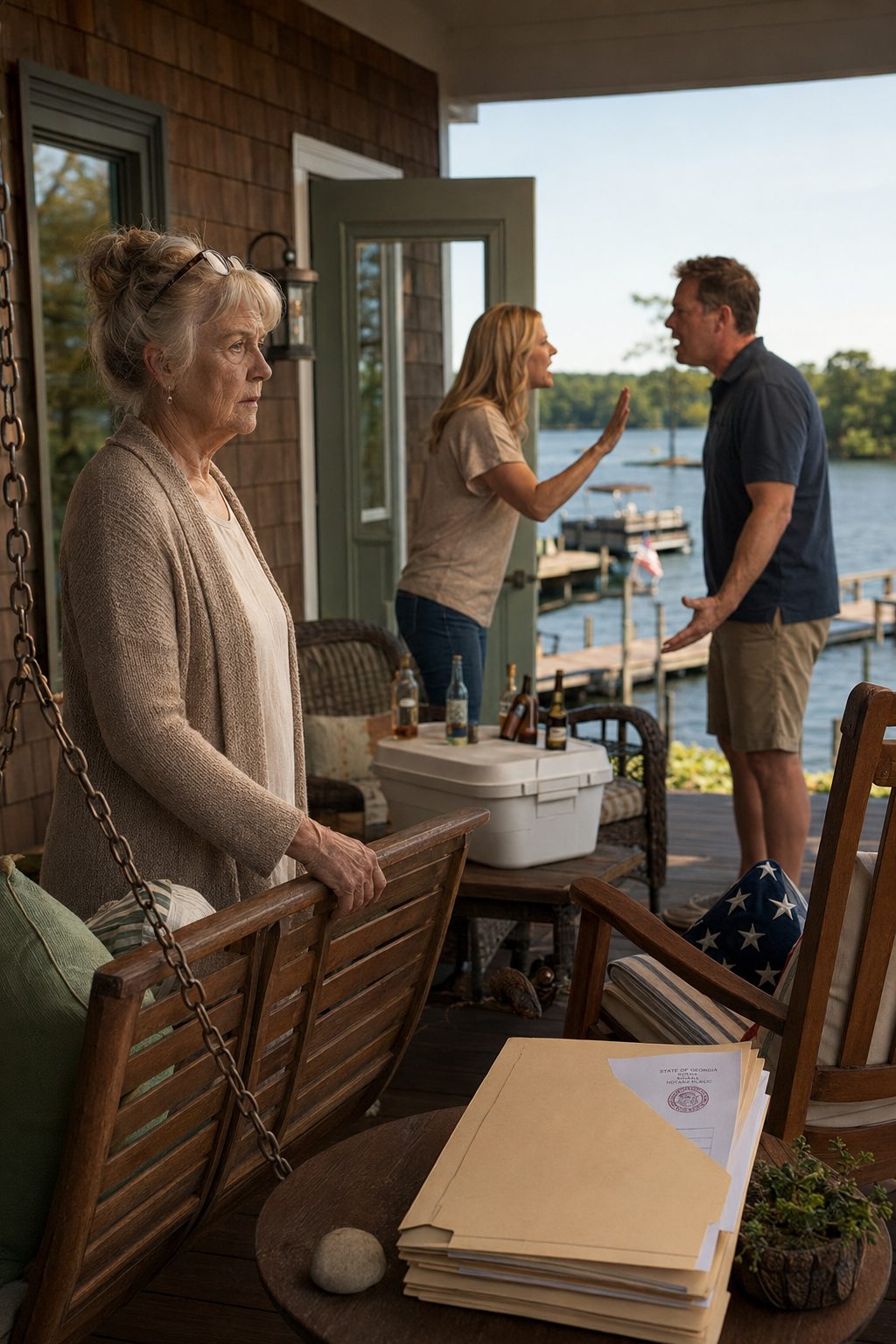
Tom had not come for the Fourth of July fireworks; he had come because Margaret had asked him to walk the property line with a folder full of paperwork Claire did not know existed.
Ryan met him on the porch first, cooler in hand, still in his flip‑flops, and asked, “Can I help you? This is a private event.”
Tom replied, “I’m here for Mrs. Ellis. We have some paperwork to go over.”
Claire came out wiping her hands on a dish towel—the same towel from Thanksgiving—and her face did something complicated when she saw the folder under Tom’s arm.
“Mom, what is this?” Claire asked, her voice tinged with surprise.
Margaret rose from the porch swing slowly, the way Thomas used to stand up right before he said something he had been thinking about for a long time.
“This is the deed,” she said, “and the trust I set up in December, the one that puts this house in Daniel’s name and mine, with a clause that nobody transfers, sells, or mortgages it without both our signatures.”
She added that the trust had been notarized the same week her husband’s lawyer had sent her the letter about simplifying things.
Ryan’s face went the color of the porch railing as the words sank in.
“You can’t just—Claire, tell her—” he began, but Claire cut him off.
“Tell her what?” Claire said, and her voice cracked in a way Margaret had not heard since she was nineteen and scared.
“Mom, we just wanted—” Claire started, but Margaret interrupted.
“I know what you wanted,” Margaret said firmly. “I read the letter twice.”
Kevin’s mother set down her cooler as if it had suddenly grown heavier, and nobody moved toward the dock.
The fireworks that someone had planned for later sat forgotten in a paper bag by the door.
Tom laid the folder on the porch table unhurried, the way his father used to lay out blueprints, and began to speak.
“Mrs. Ellis retains full ownership,” he said. “Any future decisions about this property require her consent and her son’s. That’s not going to change.”