
Part 1: The Unexpected Thanksgiving Phone Call
My kitchen still smelled like pumpkin pie, black coffee, and cinnamon. Freezing rain tapped against the windows of my Columbus, Ohio, home, and the little flag on the porch snapped hard in the wind. Then my phone rang. Ryan. He never called unless he wanted something moved, signed, hidden, or forgiven. His mother, Diane, was worse. She could turn any kindness into an obligation and any disagreement into proof that someone had disrespected her family. To them, I was simply Margaret Hayes. A sixty-three-year-old widow with an old SUV, grocery coupons in my purse, and birthday cards with cash tucked inside. They had never once asked what I had done before retirement. I answered. “Come pick up your garbage,” Ryan said. My hand tightened around my coffee mug. “Where is Emily?” “Downtown bus terminal. Your daughter decided last night was the perfect time for a breakdown. I’m hosting my CEO for Thanksgiving dinner, and I don’t have time for drama in my house.” Emily was twenty-eight, a structural engineer, and one of the calmest people I knew. She made spreadsheets for camping trips. She labeled moving boxes by room and weight. Emily did not have breakdowns. Somewhere behind Ryan, Diane laughed. “Tell her to take that pathetic girl back where she came from,” she said loudly enough for me to hear. “And tell her I expect payment for my five-thousand-dollar rug.” I stared at the dark kitchen window. “What happened to the rug?” Ryan went quiet for half a second. Then his voice hardened. “Go get her, Margaret. The caterers arrive in four hours. And do not bring her back here.” The call ended. For three years, I had watched Emily become quieter. She stopped wearing bright colors because Ryan said they attracted attention. She stopped meeting old coworkers for drinks because he accused her of embarrassing him. At family dinners, Diane corrected the way Emily spoke, cooked, dressed, and eventually even the way she laughed. I had challenged some of it. Not enough. Ryan believed my restraint meant weakness. He had no idea that before arthritis, retirement, and my husband’s long illness changed the shape of my life, I had spent more than two decades as a federal prosecutor. I had interviewed frightened witnesses. I had listened to confident men explain why evidence supposedly meant nothing. I knew something important about people who thought they were untouchable. They talked too much. So I did not call Ryan back. Anger mattered later. Facts mattered now. I pulled on my winter coat, grabbed my keys, then opened the hallway closet. Behind a stack of photo albums sat a small gray lockbox I had not opened in years. I took it with me. At 5:43, I reached the downtown bus terminal. The waiting room was almost empty. A maintenance worker was mopping near the vending machines. Two travelers slept beneath coats pulled over their faces. Emily was not inside. I found her outside near Bay 6. She was curled on a metal bench beneath a flickering light. No coat. One shoe. Her hair was damp from freezing rain, and she was shaking so hard her teeth clicked when she tried to speak. “Mom.” I dropped beside her. “Emily. Look at me.” Her fingers caught the sleeve of my coat. “They hurt me.” “Who?” Her eyes filled. “Ryan and Diane.” I kept my voice level. “Can you tell me what happened?” She looked past me toward the empty street. “Melissa was there.” I knew the name. Ryan’s executive assistant. “She came for Thanksgiving?” I asked. Emily swallowed. “She came with luggage.” That was when I understood this had not been a holiday argument. Emily gripped my sleeve harder. “He said she was staying. I told him I wanted to leave. Diane blocked the door.” Her voice broke. “They took my phone. Ryan said nobody would believe me anyway.” Then Emily’s eyes rolled back. Her weight collapsed against me. At 5:47, I called 911. The ambulance arrived first. A patrol officer came minutes later. At the emergency department, a nurse took Emily behind a curtain while another officer asked me what I knew. “Only what she told me,” I said. That was the answer he needed. Not speculation. Not revenge. Evidence. The nurse later returned carrying a clear property bag. Inside were Emily’s torn purse strap, one earring, and a crumpled Thanksgiving place card she had apparently shoved into her pocket before being forced from the house. The officer asked whether Emily had somewhere safe to go after discharge. “Yes.” Then he asked the question Ryan should have worried about long before he called me. “Mrs. Hayes, is there anything else we should know?” I looked toward the treatment room. Then I opened the gray lockbox. Inside was my retired federal credential case. The badge itself gave me no special authority now. I knew that better than anyone. But tucked beneath it was an old card containing the direct number of someone who still answered when I called. A former investigator I had trusted for eighteen years. I took out my phone. Across town, Ryan and Diane were preparing crystal glasses, warming dinner rolls, and setting an extra place for Melissa as if Emily had simply disappeared from their schedule. I dialed the number. A familiar voice answered on the third ring. “Margaret?” “Yes.” I looked through the hospital glass at my daughter. “I need you to help me find out exactly what my son-in-law thinks he just got away with.” Sometimes protecting your child means resisting the urge to act before the facts are clear. And sometimes the quietest person in the room is quiet because she already knows what evidence can do.

Part 2: A Mother’s Journey to Her Daughter
His name was Daniel Mercer. He had worked investigations with me for nearly eighteen years before we both retired from federal service. I did not ask him to arrest anyone. He could not have done that even if I wanted him to. I asked him for something more useful. “Tell me who to call so this is handled correctly.” Daniel was silent for a moment. Then he said, “Start local. Preserve everything. Don’t warn Ryan.” Exactly what I had already been thinking. Emily regained consciousness shortly after seven. A doctor examined her while an officer waited outside. When Emily was ready, she gave a full statement. Slowly. Carefully. No exaggeration. Ryan had brought Melissa home Wednesday evening and announced that their marriage was over. He expected Emily to leave before Thanksgiving dinner. Emily refused to be thrown out of her own home without her belongings. The argument escalated. Diane took Emily’s phone. Ryan blocked her when she tried to retrieve it. When Emily attempted to leave through the front door, Diane grabbed her coat and pulled it away. Emily fell against a side table. The expensive rug Diane had mentioned? A glass of red wine had spilled on it during the struggle. That was the “five-thousand-dollar damage” they were angry about. Eventually Ryan drove Emily downtown. He left her at the bus terminal without her coat, phone, wallet, or one of her shoes. Then he went home. By eight thirty, an officer had photographed Emily’s injuries and collected what evidence she had. A detective contacted me shortly afterward. I gave him the one thing Ryan had generously provided himself. The voicemail. He apparently had not realized that after our call disconnected, he had called again while my phone was in my coat pocket. I had missed it. Ryan had left a message. His voice was unmistakable. “So she’s gone, right? Keep her away until after dinner. Melissa’s already here, and Mom cleaned up the mess.” I played it once for the detective. He did not smile. Neither did I. At 10:15 that morning, while Ryan’s caterers arranged serving trays and Diane polished silverware, officers went to the house. Melissa opened the door. She told them Emily had “become hysterical” and left voluntarily. Then Diane appeared and repeated almost the same wording. Ryan came downstairs a few minutes later. He was furious that police had interrupted his Thanksgiving. According to the detective who later spoke to me, Ryan spent the first ten minutes trying to explain how important his guests were. That was Ryan. Even then, he thought status was evidence. The problem was that Emily’s phone was sitting on the kitchen counter. Her wallet was in Ryan’s desk drawer. Her winter coat was in the garage. And the home-security system had recorded portions of the previous night. Ryan had forgotten about the camera mounted above the front hallway. There was no dramatic federal raid. No old colleagues stormed the dining room because I had once carried a badge. That is not how the law works. What happened was quieter. And much worse for Ryan. Local investigators followed the evidence. Emily obtained an emergency protection order. Ryan was arrested after detectives reviewed the recordings and statements. Diane was also charged for her role in preventing Emily from leaving and taking her phone. The exact charges changed as the case moved through the county prosecutor’s office, but the Thanksgiving dinner Ryan had spent weeks arranging never happened. His CEO left before the turkey was carved. Melissa left shortly afterward. By evening, Ryan’s dining room was empty. Emily spent Thanksgiving at my house. She wore one of my old sweatshirts and thick wool socks. She barely ate. Around six, I warmed a bowl of mashed potatoes and set it beside her on the couch. She stared at it for a while. Then she whispered, “I should have told you sooner.” I sat beside her. “You’re telling me now.” She looked at the gray lockbox on my coffee table. “You really were a federal prosecutor?” I laughed for the first time that day. “Twenty-three years.” Emily blinked. “Ryan thought you worked in an office.” “I did work in an office.” That made her smile. Only for a second. But it was enough. The months afterward were not simple. There were lawyers, hearings, statements, financial records, and the painful work of separating two lives that had been tangled together for years. Emily filed for divorce. She returned to her engineering firm after taking leave. She found a small apartment twenty minutes from me. The first thing she bought for it was a bright yellow chair. Ryan had always hated yellow. I never used my former title to intimidate anyone. I never asked an old colleague for a favor that the law did not allow. The most important thing my career had taught me was that authority means nothing if it is used outside the rules. What mattered was knowing those rules existed. Knowing how to preserve evidence. Knowing when not to warn someone. Knowing that a frightened person deserves to be heard before a powerful one gets to rewrite the story. The following Thanksgiving, Emily came to my house before sunrise. She brought coffee, two pies, and a ridiculous yellow scarf that matched her chair. At 5:02, my phone stayed silent. Emily noticed the time anyway. She looked at me across the kitchen. “Funny,” she said. “Last year I thought that morning was the end of everything.” I poured her coffee. “It was the end of something.” She nodded. Then she opened the curtains and let the morning light into the room. For the first time in years, my daughter was no longer asking permission to take up space in her own life.
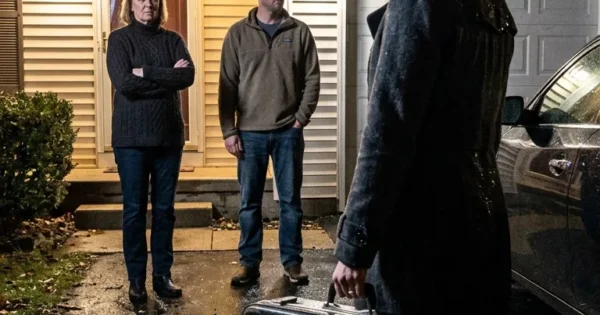
A retired mother stands beside her SUV at a freezing Ohio bus terminal before dawn as she finds her adult daughter trembling alone on a metal bench.
Discover more heartwarming stories and emotional moments on our main editorial page.

The gentlemen Said Nobody Was Coming to Save Me — An Inspiring Family
Read Full Story ➡️