
Part 1: The Little Girl Who Promised to Pay for Bread Someday
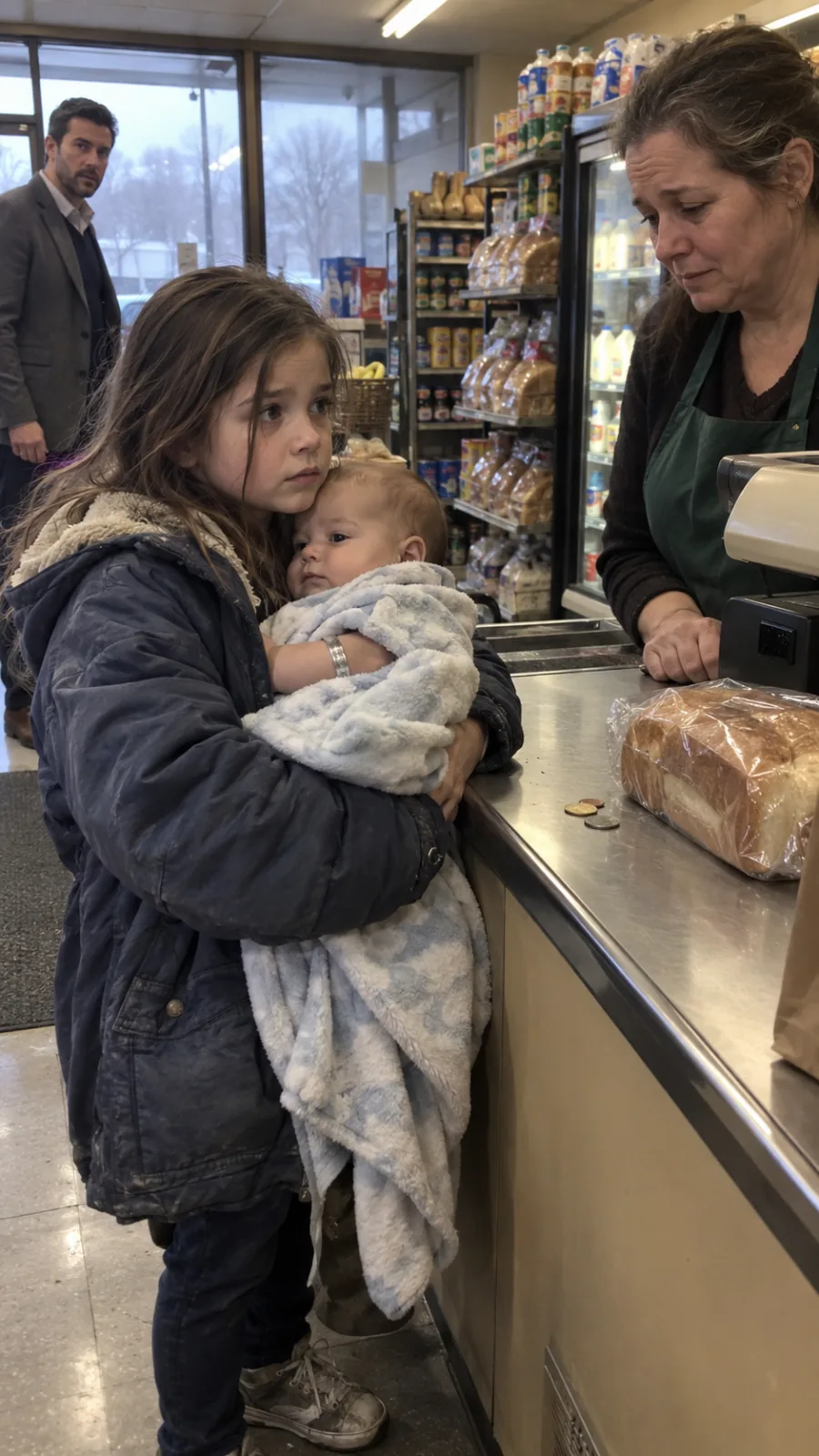
Lily had been walking since morning with her baby brother pressed against her chest. The wind moved through the parking lot in thin, cold strips, sliding under her sleeves and making Noah curl closer beneath the faded blanket. She was eight years old, old enough to know when a grown-up was lying and young enough to still believe a promise could fix something if she meant it hard enough. Noah had cried for most of the morning. By afternoon, the cries had changed. They were smaller now, little tired sounds that made Lily’s throat tighten. She kept bouncing him the way her mother had shown her, one hand under his back, one hand cupping the blanket around his head. “Almost there,” she whispered, though she did not know where there was. Their mother, Amelia, had been sick for days. Not the kind of sick where someone made soup and tucked you in. The kind where she could not stand long enough to hold Noah, and her voice became so soft Lily had to lean close to hear it. That morning, Amelia had touched Lily’s cheek and said, “Go to Mrs. Alvarez downstairs. Tell her I need help.” But Mrs. Alvarez had not been home. Lily waited in the hallway, knocked again, then walked outside because Noah was hungry and she could not make milk appear from an empty kitchen. For a while, she thought she could be brave enough for all three of them. Then she saw the grocery store. It sat at the corner of a tired block in Dayton, Ohio, with fogged windows and a bell over the door. Inside, warm light fell across stacked oranges, cereal boxes, and a bakery shelf near the counter. Bread. A plain loaf in a clear plastic bag. Lily stopped so fast Noah whimpered. She shifted him higher on her hip and counted the coins in her coat pocket. Two quarters, three dimes, a nickel, and pennies she had found in the drawer beside the sink. She counted them once. Then again. The second count did not make them grow. Still, she went inside. The bell gave a small bright ring. A man behind the counter looked up from a receipt book. He was not cruel-looking, just tired, with reading glasses low on his nose. Lily walked straight to the bread before she could lose courage. She chose the cheapest loaf and held it carefully against Noah’s blanket. At the counter, she placed the bread down, then put every coin beside it. The store owner counted in silence. His mouth pulled to one side. “You’re short.” Lily swallowed. “How much?” He told her. It sounded enormous. She looked at the coins, then at Noah. His eyes were squeezed shut, his little face red with effort, but his cry barely came out. “Please,” Lily said. “Can I take it and bring the rest later?” The owner rubbed his forehead. “Honey, I can’t run a store like that.” “It’s for my brother.” “I understand, but I can’t.” Lily stared at the loaf. She could feel people moving behind her, someone opening a cooler, someone setting a basket down. Shame burned across her cheeks, but she did not move away. Instead, she pushed the coins closer. “I’ll pay you back when I grow up,” she said. “I promise.” Behind her, the bell over the door had already stopped ringing, but the man who had just entered did not take another step. Michael Bennett stood between the front mat and the produce display, one gloved hand still on the handle of the door. He was dressed like someone who belonged in a different part of town: gray blazer, clean shoes, a watch that caught the store light when he lowered his hand. He had come in for bottled water on his way from a meeting. Then he heard Lily’s promise. And then he saw Noah. The blanket had slipped just enough to show the baby’s small wrist. Around it was a thin silver bracelet, old and polished from years of being touched. A single letter was engraved near the clasp. M. Michael’s face changed so quickly the store owner noticed. For fourteen years, that letter had lived in his memory like a door he could not open. His daughter Amelia had worn that bracelet the night she disappeared at sixteen, after an argument Michael had replayed until every word felt like a bruise. He stepped closer, careful not to frighten the girl. “Sweetheart,” he said, his voice barely steady, “where did that bracelet come from?” Lily pulled Noah closer. “It’s my mama’s,” she said. Some promises are made because a child has no other weapon against hunger. And some objects carry a whole family history before anyone is ready to speak it aloud.
Part 2: The Heartwarming Resolution
(Part 2) Michael did not reach for the bracelet. Something in Lily’s face warned him that if he moved too fast, she would run. So he took one slow breath and looked at the store owner. “Add the bread to my bill,” he said. “And milk. Formula, if you carry it. Soup. Crackers. Anything a sick mother might keep down.” The owner blinked. “Sir?” “Please.” That one word changed the air in the store. Lily watched him carefully, still holding Noah like the world might try to take him. Michael crouched, leaving space between them. “What’s your mama’s name?” he asked. Lily hesitated. Noah made a weak little sound against her shoulder. “Amelia,” she said. Michael closed his eyes. For a moment, all the money he had made and all the years people had called him powerful meant nothing. He was just a father in a grocery store, hearing the name he had whispered into too many empty rooms. “Amelia Bennett?” he asked. Lily’s eyes widened. “How do you know that?” The store owner stopped bagging. Michael looked at Noah’s bracelet again. “Because Amelia is my daughter.” Lily took half a step back. “My mama said her family was gone.” The words landed harder than Michael expected. “Maybe she believed that,” he said quietly. “But I never stopped looking for her.” He asked where Amelia was, and this time Lily gave him the address, though her voice shook over every number. Michael paid for the groceries, then handed the owner his card. “Call for medical help,” he said. “Tell them there’s a sick adult and an infant who may need attention. I’ll meet them there.” Then he turned back to Lily. “You can ride with me, or we can wait right here until help comes. Your choice.” Lily studied him. Children who have been disappointed by adults do not trust kindness quickly. At last, she nodded toward the window. “My mama needs the bread.” Michael drove slowly, with Lily in the back seat beside Noah, one hand on the groceries and the other on her brother’s blanket. She did not ask questions. Neither did he. The silence was full enough. The apartment building had cracked steps and a lobby light that flickered. Michael carried the bags while Lily led him upstairs. At the door, she knocked twice, then pushed it open. “Mama?” Amelia was on the couch beneath a thin quilt, pale and awake, trying to sit up before her body allowed it. Her hair was shorter than Michael remembered. Her face was older. But the eyes were the same. Michael stopped in the doorway. Amelia stared at him like she had seen a memory become a person. “Dad?” she whispered. Lily looked from one adult to the other. No one spoke for several seconds. Then Michael set the groceries down, slowly. “I found them at the store,” he said. “I saw the bracelet.” Amelia’s hand went to her mouth. “I put it on Noah when he was born,” she said. “I thought if anything ever happened to me, maybe someone would know where he belonged.” Michael’s face folded with pain. Fourteen years earlier, he had told his sixteen-year-old daughter that if she walked out after choosing a boy he did not trust, she should not expect him to come chasing after her. It had been pride, fear, and anger dressed up as discipline. By midnight, he had regretted it. By morning, she was gone. “I did chase after you,” he said. “Just too late.” Amelia began to cry, not loudly, not dramatically. Just the tired kind of crying that comes when a person finally stops holding a door shut from the inside. Medical help arrived minutes later. Michael rode behind the ambulance, Lily asleep in the passenger seat of his car with the loaf of bread still in her lap. In the weeks that followed, Amelia recovered slowly. There were doctors, paperwork, careful conversations, and nights when nobody knew how to say the simple things first. Michael did not try to buy forgiveness. He showed up. He made breakfast. He learned how Noah liked to be rocked. He walked Lily to school and waited where she could see him. One afternoon, Lily found her coins in a small glass jar on Michael’s kitchen shelf. “You kept them?” she asked. Michael nodded. “You said you’d pay me back when you grew up.” Her face fell. He knelt in front of her. “Lily, you already did. You brought my daughter home.” Years later, when Michael Bennett donated a small grocery fund for families, he named it after Lily’s promise. But in his own house, the first loaf of bread they bought together mattered more than any building, because it was the day hunger led a lost family back to the table.
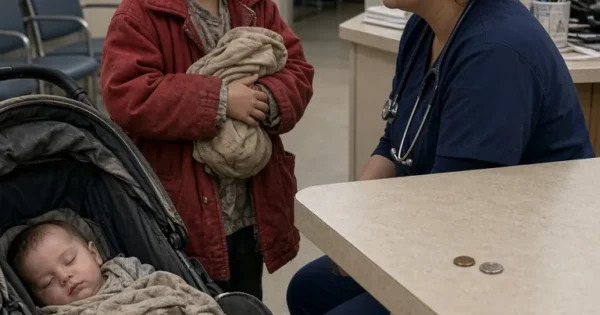
Eight-year-old Lily stands at a small Dayton grocery counter with baby Noah in her arms, offering her last coins for a loaf of bread.
Discover more heartwarming stories and emotional moments on our main editorial page.