

Part 1: The Unexpected Encounter
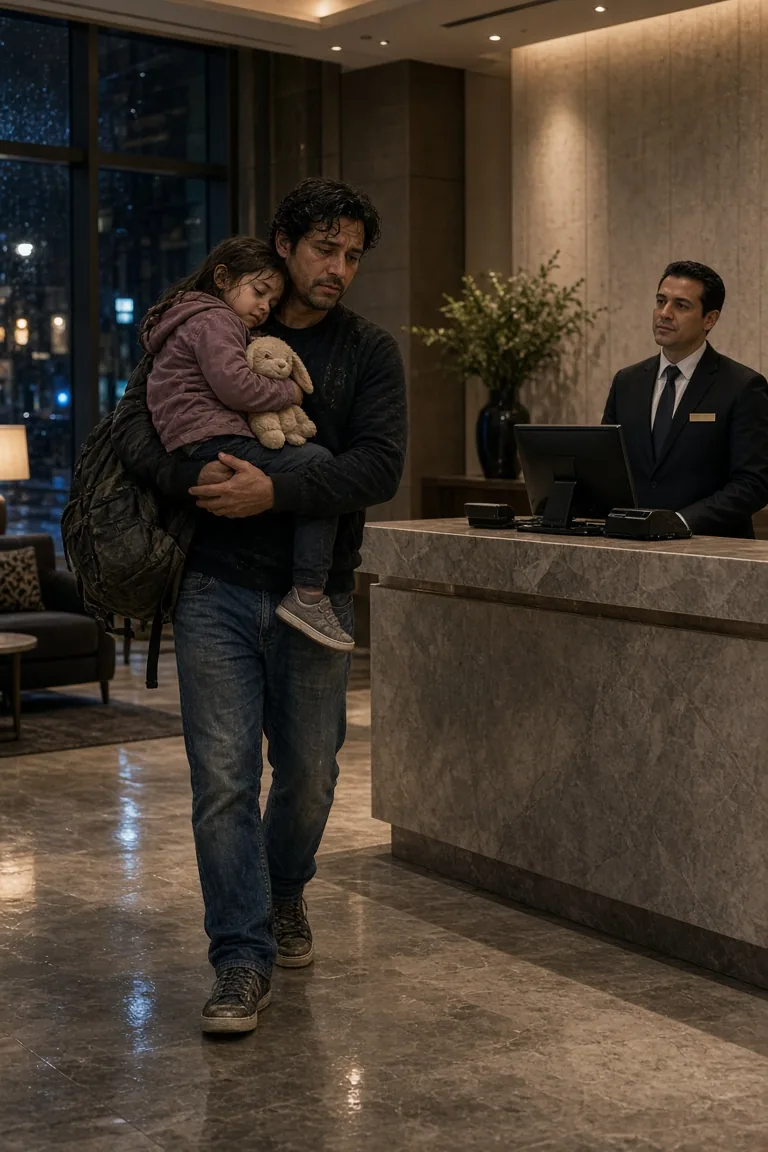
At 12:17 a.m., Santiago Arriaga walked into the Mirador Riverwalk Hotel in San Antonio carrying his seven-year-old daughter in both arms. He did not look like the man whose name appeared on the company’s incorporation papers. He wore a rain-darkened black sweatshirt, faded jeans, worn sneakers, and an old backpack slung over one shoulder. Valentina slept against his chest with a small plush rabbit tucked beneath her chin, the souvenir she had begged for during their layover at Guadalajara airport. Their flight had been delayed for hours by storms. By the time they reached downtown San Antonio, Santiago wanted only three things: a clean room, a hot shower, and a few quiet hours before his daughter had to hear another airport announcement. For four months, he had been moving between properties in the hotel group he had built from one struggling roadside inn into a regional chain. He reviewed renovation delays, vendor bills, occupancy numbers, and employee complaints. He could have called ahead. He could have asked the regional manager to reserve the largest suite. He could have arrived in a company car. Instead, he had come through the lobby doors like any tired parent. That was intentional. Santiago’s mother, Mercedes, had spent nearly thirty years cleaning hotel rooms after immigrating from Puebla. She used to tell him that politeness meant very little when people were being watched. “Your education shows,” she would say, “when you’re kind to someone you think can do nothing for you.” Years later, Santiago turned that sentence into company policy. Behind the front desk at every Arriaga property was a brass plaque that read: Every person who enters this hotel will be treated with dignity before money, status, or reservation is considered. At the Mirador Riverwalk, the plaque hung directly behind the night receptionist. His name tag said BRUNO MALDONADO. His uniform was immaculate. His hair was carefully styled. His smile looked practiced. But when Santiago approached the counter, Bruno did not look at his face first. He looked at the wet sneakers. Then the old backpack. Then the sweatshirt. Finally, he glanced at the sleeping child. The smile disappeared. “Good evening,” Santiago said quietly. “I need a room for tonight. Anything available is fine.” Bruno tapped several keys. His eyes barely moved across the screen. “I’m sorry, sir. We’re fully booked.” Santiago shifted Valentina slightly so her head rested more comfortably against his shoulder. “My flight was delayed. I can pay now.” Bruno leaned forward and lowered his voice. “This really isn’t a stopover hotel.” Santiago stared at him for a second. He had heard worse words in boardrooms, negotiations, and construction meetings. Still, that sentence landed differently with his daughter asleep in his arms. “I’m just asking whether you have a room.” “We don’t.” “Nothing at all?” “Completely full.” Santiago nodded once. He did not argue. He stepped away from the desk and stood near a lobby column while rain tapped the tall windows facing the street. Three minutes later, the revolving door turned again. An elegant couple entered beneath a large umbrella, laughing about the weather. They carried no luggage beyond a handbag and a leather briefcase. Bruno’s expression changed immediately. “Welcome,” he said brightly. The man asked whether there was any chance of getting a room without a reservation. Bruno smiled. “Of course. We still have a king room with a River Walk view.” Santiago watched him prepare two key cards. He heard him mention breakfast. He heard the woman thank him for “saving the night.” Then Valentina moved against his shoulder. Her eyes opened slowly. “Dad?” “I’m here.” She looked at the couple walking toward the elevators, then back at the counter. Her voice was sleepy enough that she did not know she was asking the one question no adult in the lobby wanted to answer. “Dad… why do they get to sleep here, but we don’t?” The couple stopped. Bruno froze. Santiago looked at his daughter, then at the brass plaque behind the desk. For the first time that night, he set his backpack carefully on the floor. Then he walked back to the counter. “Bruno,” he said, reading the name tag, “please call your overnight manager.” Bruno’s jaw tightened. “And what should I tell her this is about?” Santiago kept one arm around Valentina. “Tell her Santiago Arriaga is waiting in the lobby.” A rule means little if it disappears when status is invisible. Respect matters most before anyone knows who is standing in front of them.
Part 2: A Lesson in Politeness and Family
(Part 2) Bruno stared at him. For a moment, nothing changed. The lobby still smelled faintly of coffee and rain. The elegant couple remained near the elevators. Valentina rested against Santiago’s shoulder, awake now, one hand wrapped around the ear of her plush rabbit. Then Bruno gave a short, skeptical laugh. “Mr. Arriaga, our manager is busy.” Santiago’s voice stayed even. “Please call her.” Something in his tone finally made Bruno reach for the phone. Less than two minutes later, a woman in a navy blazer came through a side door behind the desk. Her name was Leah Benton, the hotel’s overnight manager. She was already speaking as she approached. “What seems to be—” Then she saw Santiago. She stopped. Her face changed completely. “Mr. Arriaga?” Bruno’s hand remained on the telephone. The couple by the elevators turned around. Leah looked from Santiago to Valentina, then to the old backpack on the floor. “I didn’t know you were coming tonight.” “That was the point,” Santiago said. He did not sound angry. That made the silence worse. Leah glanced at Bruno. Santiago asked one question. “Do we have rooms available?” Leah hesitated only a second. “Yes. Eleven standard rooms and two suites.” Bruno swallowed. “I thought—” “No,” Santiago said quietly. “You looked at me and decided.” Valentina watched the adults without understanding all of it. Santiago picked up the backpack and turned slightly so he was speaking to Bruno without making a show for the lobby. “My daughter asked me why another family was allowed to stay here when we weren’t. I need you to understand why I couldn’t answer her.” Bruno looked down. “I made a mistake.” “You did.” “I can explain.” Santiago nodded toward the plaque behind him. “Start with that.” Bruno turned. For the first time since Santiago had entered, he seemed to actually read the words engraved there. Every person who enters this hotel will be treated with dignity before money, status, or reservation is considered. Santiago did not fire him in the lobby. He did not shout. He did not ask security to escort him out. Instead, he told Leah to take Bruno off the front desk for the rest of the shift and preserve the reservation log and lobby camera footage for a formal review in the morning. Then he asked for the same kind of room he had requested at the beginning. Not a suite. Not an upgrade. Just a standard room. Leah started to apologize, but Santiago stopped her. “The room is for my daughter. The review is for tomorrow.” Upstairs, Valentina sat on the edge of the bed while Santiago helped remove her wet sneakers. She was quiet for a while. Then she asked, “Did that man know you owned the hotel?” “No.” “Would he have been nicer if he knew?” Santiago paused. “That’s what we have to fix.” The next morning, he met with the regional manager and the hotel’s HR lead. They reviewed the room inventory, the transaction created for the other couple, and the lobby footage. Bruno had not misunderstood the occupancy. He had made a choice based on who he believed belonged there. The company placed him on leave while the incident was formally reviewed. But Santiago did not stop with one employee. Within the month, Arriaga Hotels changed its mystery-guest program. Evaluators no longer arrived only in business clothes or under corporate names. They came as tired parents, construction workers, elderly travelers, young couples, solo guests with backpacks, and people asking basic questions without signaling wealth. Managers were told to measure courtesy before upgrades, sales, or loyalty status. And the brass plaque behind every desk was moved lower, directly into the receptionist’s line of sight. Months later, Santiago returned to the Mirador Riverwalk with Valentina. This time, she was wide awake. A new receptionist welcomed them before asking for a reservation. Valentina looked at the plaque, then at her father. “Is this the rule Grandma Mercedes taught you?” Santiago smiled. “Yes.” She squeezed his hand. “Then people should follow it even when they don’t know who you are.” Santiago looked across the lobby where his mother’s lesson had nearly become nothing more than decoration. “That,” he said, “is exactly when it matters most.”
A rain-soaked father in a black sweatshirt carries his sleepy seven-year-old daughter toward a polished San Antonio hotel front desk late at night.
Discover more heartwarming stories and emotional moments on our main editorial page.

The Little Girl Who — An Inspiring Story — An Inspiring Family Story
Read Full Story ➡️